
(702) 676-1899 charlestonblvd@rtcsnv.com
A Faster, Safer, Improved Charleston Boulevard Is On The Horizon
Frequently Asked Questions
What is the Charleston Alternatives Analysis?
The Charleston Boulevard Alternatives Analysis is a transportation study focused on identifying transformative transportation improvements along Charleston Boulevard. Led by the Regional Transportation Commission (RTC) of Southern Nevada, in collaboration with the City of Las Vegas and the Nevada Department of Transportation (NDOT), the goal is to improve the travel experience along Charleston Boulevard. This project will introduce faster, safer, and more reliable transportation options while enhancing safety and accessibility for everyone traveling along the corridor. Multiple long-range plans, including the City of Las Vegas 2050 Master Plan and the RTC’s On Board Mobility Plan, have recommended Charleston Boulevard as a key corridor for improved safety and additional mobility options, serving both residents and visitors across the valley.
Why is Charleston Boulevard the focus of this project?
Charleston Boulevard is one of the busiest streets in Las Vegas for motorists and transit riders, with over 12,000 daily transit riders and significant traffic congestion. It is also part of the city’s High Injury Network, where a high percentage of serious crashes occur. The corridor connects key destinations like Downtown Summerlin, the Las Vegas Medical District, and Downtown Las Vegas, making it a critical route for both local and regional mobility.
Charleston serves a main street function without a main street feel. So many people travel through the corridor on any given day, but there are few vibrant neighborhood hubs along the route that draw people in, great places where people want to gather and spend time. Nearby areas like the Arts District provide a contrast to the vacant lots which line portions of the corridor today, signaling its underinvestment while also reflecting abundant possibilities. All throughout the corridor exist opportunities for bustling neighborhood centers, great places that people are proud of and want to visit, which reflect the character and culture of their surroundings.
Beyond benefits within the corridor, improved mobility on Charleston keeps the economy of Las Vegas moving, growing and thriving. It connects businesses with employees and connects workers to their livelihoods. Even for those just passing through Charleston, connecting people to their destination safely, quickly and reliably keeps our whole city moving well.
What is being studied?
- Enhanced Safety: Safer and more comfortable spaces for people traveling along Charleston Boulevard, especially for those on foot or riding their bicycles.
- More Capacity: Move more people through the boulevard more efficiently, reducing congestion and travel times while improving reliability.
- Improved Transit: Deliver faster, safer, more frequent, and reliable service.
- Growth: Adapt the transportation system to keep up with rapid regional growth.
- Connected Corridors: Link to major corridors like Downtown Las Vegas, Maryland Parkway, Boulder Highway, and the Resort Corridor.
- Quality of Life: Improve access to jobs, education, healthcare, and recreation.
- Community Benefits: Provide opportunities for economic development, new jobs, housing, community beautification, and new neighborhood hubs.
What will the project improve?
The project will improve:
- Travel experience: Safe and seamless travel experience for people who walk, bicycle, take transit or drive in the corridor, where people can move easefully and safely, have a myriad of great transportation options, and know that whatever they choose will provide them with quick, convenient and reliable access to wherever they’re headed along Charleston.
- Safety: Enhanced crosswalks, wider sidewalks, improved lighting, and better transit stations.
- Quality of Life: Better access to jobs, schools, services and essential community destinations for everyone. Beautification and creation of vibrant neighborhood hubs.
- Economic Growth: Encouraging transit-oriented development (TOD) with mixed-use neighborhoods.
- Experience for Drivers: Alleviating traffic congestion due to regional growth by providing a high-quality alternative to driving, and improving road safety.
How does this project support safety?
Charleston Boulevard has one of the highest rates of crashes that involve people walking or riding bicycles in the city. Safety upgrades, such as wider sidewalks, accessible curb ramps, improved crossings, better lighting, and dedicated space for people biking, will make the corridor safer for all users, both on Charleston and on connecting routes to the corridor.
Who will benefit from this project?
- The project will serve all people traveling in the corridor now, including:
- Everyone who travels through Charleston Blvd on a regular basis.
- Transit riders who need faster, more reliable service.
- Residents of communities with fewer cars or limited transportation options.
- Businesses seeking better customer access.
- Employers who need connections to the workplace for their employees.
- People who drive and would be affected by increasing traffic congestion as the region grows.
- People who walk and bike who need safer streets and crossings.
- People moving to or within the corridor, who will benefit from more high-quality housing options.
What is the RTC looking for in terms of input from the community?
Early public engagement is essential to ensure the project reflects the community’s needs, priorities, and vision. By involving the public during the earliest planning phase, we create an opportunity for residents, workers, and travelers to help shape the future of Charleston Boulevard. Input gathered now will directly inform the project team’s decisions and help guide transportation solutions that are both effective and community driven.
The survey is open through the end of August, and we want to hear from everyone who lives, works, or travels along the corridor. Those interested can participate by completing the survey, talking with us at community events, or reaching out directly at CharlestonBlvd@rtcsnv.com. The community’s feedback is critical in helping us build a safer, more connected, and more reliable Charleston Boulevard for everyone.
What transportation options are being studied?
We are evaluating a broad range of potential transportation alternatives including light rail, bus rapid transit, and rapid bus service to address critical safety and mobility challenges along the corridor.
In addition to transit options, improving safety on Charleston Boulevard is a top priority, as this roadway is part of the Safer Streets Priority Network and has some of the highest concentrations of serious and fatal crashes in the valley. The study is also looking at other potential improvements including wider sidewalks, accessible curb ramps, improved crossings, better lighting, and dedicated space for people biking – all aimed at creating a safer, more connected corridor for all users along Charleston and its connecting routes.
What are the issues with current transit service on Charleston?
Route 206’s travel times show there’s a clear need for improvements. Over a typical weekday, buses operate at an average scheduled speed of 12.1 MPH in service. That number drops during the day, and afternoons are the slowest, about 10.5 MPH for the full route. The section between Rainbow and Pecos is the biggest bottleneck, with an average scheduled speed of only 8.7 MPH.
In the afternoon peak (around 3 PM on a weekday), it can take more than an hour to go just over nine miles between Charleston & Rainbow and Charleston & Pecos — 62 minutes eastbound and 64 minutes westbound.
Faster speeds would improve service reliability, shorten trip times, and make transit more attractive and efficient for riders.
What happens once people provide input?
After the survey closes at the end of August, the project team will incorporate the community’s input into the next phase of the study – screening the initial list of potential alternatives. These options will be evaluated to determine which best meet the project’s goals, address community needs, and support the overall purpose of improving mobility, safety, and access along Charleston Boulevard. Alternatives that are not feasible or practical will be set aside.
The remaining options will then undergo a more detailed analysis using criteria such as cost, increased transit ridership increases, traffic and environmental impacts, and community benefits. This includes assessing how each alternative could enhance safety, mobility, and economic development in the area.
Once a refined list of feasible alternatives is developed, we’ll return to the community for another round of engagement – this time to gather feedback on those options and further shape the final recommendations.
Based on both the technical analysis and community input, a locally preferred alternative will be identified by the end of 2026. This represents the option that best balances cost, benefits, and long-term feasibility.
Once identified, the selected option would move into the federal environmental review process, with construction potentially beginning as early as 2030 and service launching as early as 2033.
What is the timeline for this project?
This study is the first step towards a improved mobility experience on Charleston.
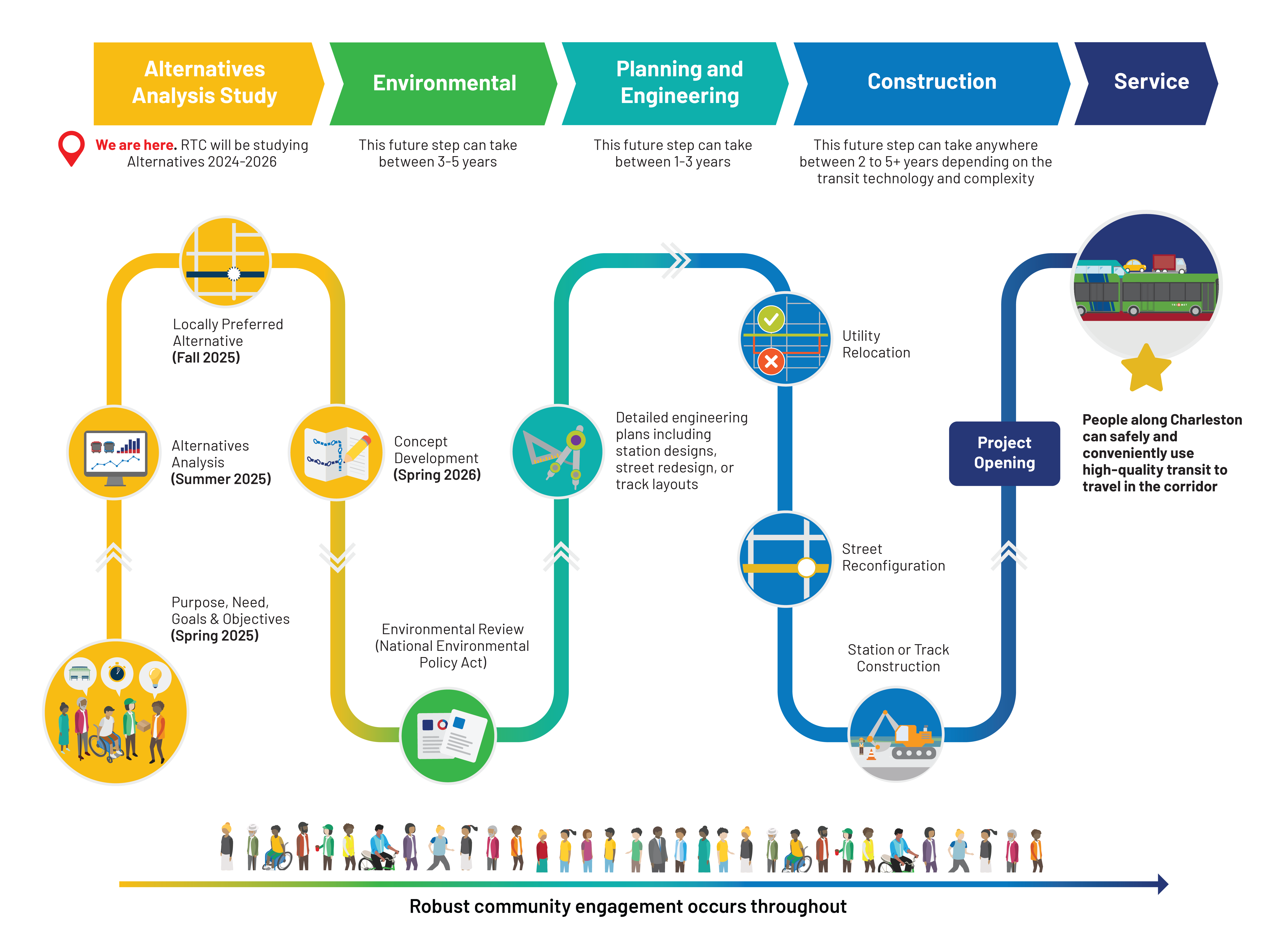
We are currently at the initial stages of this process with the study of alternatives. The study began in 2024 and will continue through 2026. After the study is complete, the project will go through environmental review and preliminary engineering.
How is the project being paid for? Where is the funding coming from?
Funding will likely include a mix of local, state, and federal sources, with opportunities to leverage grants and other resources.
The alternatives analysis is funded by a $5.9 million RAISE grant awarded to the RTC in 2023 by the U.S. Department of Transportation. Cost projections for each transit option are in development and expected later this year as part of the analysis. Transit improvements on Charleston Boulevard are currently unfunded. Before the project can move into construction, funding will need to be identified. This will likely involve a combination of local, state, and federal sources, with opportunities to pursue competitive grants and other funding resources.
What is the role of transit-oriented development (TOD) in this project?
TOD refers to creating mixed-use, walkable neighborhoods near transit stations so that getting to and from your beginning and end destination is more convenient. Better transportation has the potential to spur new economic opportunities, affordable housing, and vibrant community spaces along Charleston Boulevard.
What other plans or studies support this project?
Over the past decade, multiple plans, including the City of Las Vegas 2050 Master Plan and the RTC On Board Mobility Plan, have recommended High-Capacity Transit for Charleston Boulevard. These plans highlight the need for improved transit, safety, and economic growth in the corridor.
What is an example of improved transit on Charleston?
Two examples of high-capacity transit options that the project will study to enhance mobility along Charleston Boulevard are:
-
- Bus Rapid Transit (BRT): An enhanced bus service with features like bus-only lanes, traffic signal priority, and level boarding to reduce travel time.
- Light Rail Transit (LRT): A rail system that operates on dedicated tracks with electric-powered trains, providing high-capacity transit with minimal delays.
Is there going to be construction on Charleston in the near future for this project?
As of now, the project is in the planning and analysis phase. Construction timelines will be determined after the completion of the environmental review and detailed engineering. We don’t anticipate there would be any construction for this project on Charleston before 2030.
How will this project impact my neighborhood?
This project is about more than just transit – it’s about creating a more beautiful, connected, and welcoming Charleston Boulevard for everyone.
You can expect improvements like more greenery, better lighting, and thoughtful landscaping that make the area more attractive and inviting. These beautification efforts can help foster a sense of community pride and make this a place where people want to walk, gather, and spend time.
The project also supports thriving local businesses by making it easier for people to visit shops, restaurants, and community spaces along the corridor. By enhancing access and comfort, it helps attract development and create new neighborhood destinations where people can meet up, relax, and enjoy their community.
It’s also about making the street safer and easier to use for everyone – whether you’re walking, biking, taking the bus, or driving. Better sidewalks, safer crossings, and improved lighting are all part of the plan to make Charleston more accessible for families, kids, and seniors alike.
As part of the process, the project will also look at supportive policies to help keep long-time residents in place, ensuring that the people who already live and work along Charleston can continue to benefit from these improvements. The goal is a stronger, more connected community where everyone can share in the new benefits and opportunities on Charleston.
Will this project cause traffic?
During construction there may be temporary disruptions; however, the project’s goal is to alleviate long-term traffic congestion by providing more mobility options and ultimately making travel along Charleston more efficient, leading to improved traffic flow over time.
How many people travel through Charleston?
Charleston Boulevard carries about 35,000 vehicles and more than 11,000 transit trips daily. Introducing faster, more reliable high-capacity transit would offer a high-quality alternative to driving, easing congestion by moving more people more efficiently and helping reduce household transportation costs.
Why are you asking for my input when this is so far in advance?
Early public engagement is crucial to ensure the project meets the community’s needs and preferences. Your participation in the earliest, vision stage of the project is an opportunity to shape the future outcome of the project. By gathering input during the planning stages, the project team can make informed decisions that reflect the desires and concerns of residents and stakeholders. We believe that a proactive approach like this helps us develop future project that is more effective and community-supported.
I don’t take transit. What does this project mean for me?
Even if you don’t use public transit, the project offers several benefits:
-
- Improved Infrastructure: Upgrades to sidewalks, bike lanes, and crosswalks enhance safety and accessibility for all.
- Reduced Traffic Congestion: Improved transportation options can decrease the number of cars on the road, leading to smoother traffic flow.
- Economic Development: Enhanced transit corridors often attract businesses and services, boosting local economies and property values.
Overall, the project aims to create a more connected and livable community for everyone, including you.
How can I stay involved?
We are actively seeking input from the Charleston Boulevard Community! If you live, work, or travel in the corridor, we invite you to help shape the study outcomes through participating in this process. You can respond to our survey, speak with us at community events, or contact us at CharlestonBlvd@rtcsnv.com.